
Marketing graphic design is the visual work that carries your message to customers: campaigns, brochures, digital magazines, social graphics, landing pages and presentations, all built from one recognisable brand. It pays when the design is led by a brand idea and measured against a business goal, not produced one asset at a time. A studio that handles brand identity, art direction and publication design together, as we do at 1975 in Norwich, gives you one visual voice across every channel, which is what makes people remember you.
TL;DR
- Marketing graphic design is graphic design applied to promoting goods or services, from email and social to print and digital publications.
- The biggest returns come from consistency: one identity, one set of rules, repeated across every channel.
- Graphic design and digital marketing work as a pair. Design shapes what people see, marketing decides where and to whom it is shown.
- Agree measurable objectives before the first sketch, so you can judge the design by results.
- Brief one studio that joins brand identity, art direction and production, and the work stays cohesive as it grows.
Table of Contents
- What marketing graphic design actually covers
- Does graphic design come under digital marketing?
- The types of design that carry a marketing programme
- Four principles that make marketing design work
- Build the brand system first, then the campaigns
- Adapt the design to audience, message and channel
- Set objectives before the brief, and measure against them
- How to brief a studio so the work stays cohesive
- Where 1975 fits
- Our perspective on marketing graphic design
- FAQ
- Sources
What marketing graphic design actually covers
Marketing design is a subset of graphic design used to promote goods or services. Shopify’s guide describes the typical assets as landing pages, email campaigns and social media graphics, all supporting marketing goals and building brand consistency across channels. Its point about style is worth keeping: choices in colour, image style and text treatment tell customers what the brand is like, and applying a signature style consistently is the first step towards recognition.
For a business buying design, that gives a useful definition. Marketing graphic design is not decoration added after the strategy. It is how the strategy becomes visible. A campaign with a strong idea but mismatched typography, three different blues and photography from four different eras tells the customer the business is not quite sure who it is.
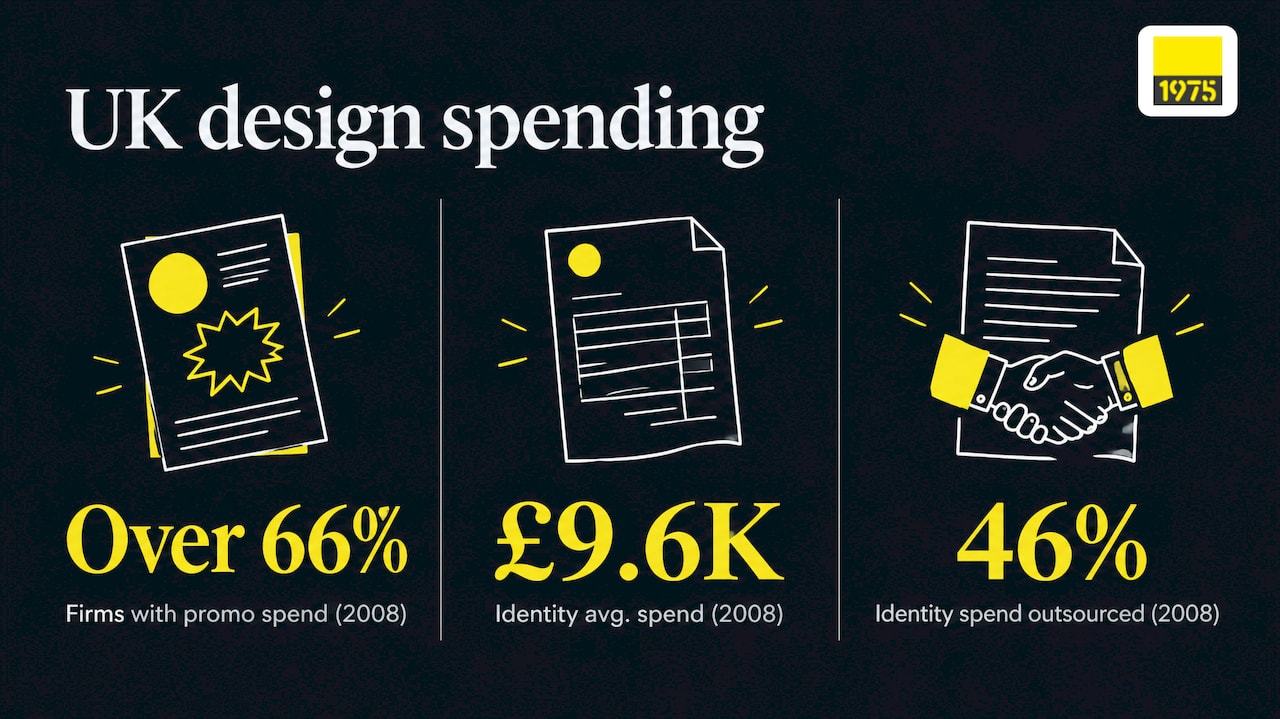
UK firms already treat it as core spending. The Design Council’s survey of 358 UK firms found promotional design, meaning advertising and promotional activity, was the most widely reported design spend, with over 66% of companies having it. The same survey found identity design (logos, corporate identity, websites and colour schemes) had the lowest average spend at £9.6K, with 46% of it outsourced. The survey dates from 2008, so read it as a picture of priorities rather than of today’s budgets. The priorities still make sense: promotional work is frequent and fast-moving, while identity is the foundation that every later piece draws on.
Does graphic design come under digital marketing?
Not strictly, but the two are tightly linked. A comparison from Bryant & Stratton explains that graphic design focuses on creating marketing materials from images and text, while digital marketing runs multi-channel campaigns and analytics. Digital marketing happens entirely online. Graphic design output can be used online or in print, and many digital marketers also do some design work.
In practice, think of it as division of labour:
- Design decides how the brand looks and reads: the identity, the layouts, the visual hierarchy, the imagery.
- Marketing decides who sees it, where, when and with what offer, then reads the numbers.
Clients no longer separate the two. The Design Business Association’s 2023 report on what clients think, based on 650 client interviews, found 91% of clients view digital as integral to communications rather than a separate service. The same research found 40% of clients are not engaging on LinkedIn or social media and need to be reached by more direct routes. That second figure matters for your design plan: a printed piece, a well-made digital magazine or a direct mailing may reach buyers your social feed never will, so the visual system has to work on every format, not just the screen.
Design also does quiet work for digital performance. Figma’s overview notes that optimised images improve site speed, clear visual hierarchy reduces bounce rates, responsive graphics suit mobile, and consistent branding builds trust. Those are marketing outcomes delivered by design decisions.
The types of design that carry a marketing programme
Shopify lists six types of graphic design: visual identity and branding, marketing and advertising, web and interface, publication and layout, packaging, and environmental design. Not every business needs all six. Most marketing programmes lean on four.
| Type | What it does for marketing | Typical assets |
|---|---|---|
| Visual identity and branding | Makes you recognisable and sets the rules everything else follows | Logo, colour palette, typography, brand guidelines |
| Marketing and advertising | Turns the brand into campaigns with a clear call to action | Campaign visuals, ads, email headers, social graphics |
| Publication and layout | Gives long-form content authority and a reason to keep reading | Digital magazines, brochures, reports, corporate literature |
| Web and interface | Carries the brand into the place where customers act | Landing pages, site templates, app screens |
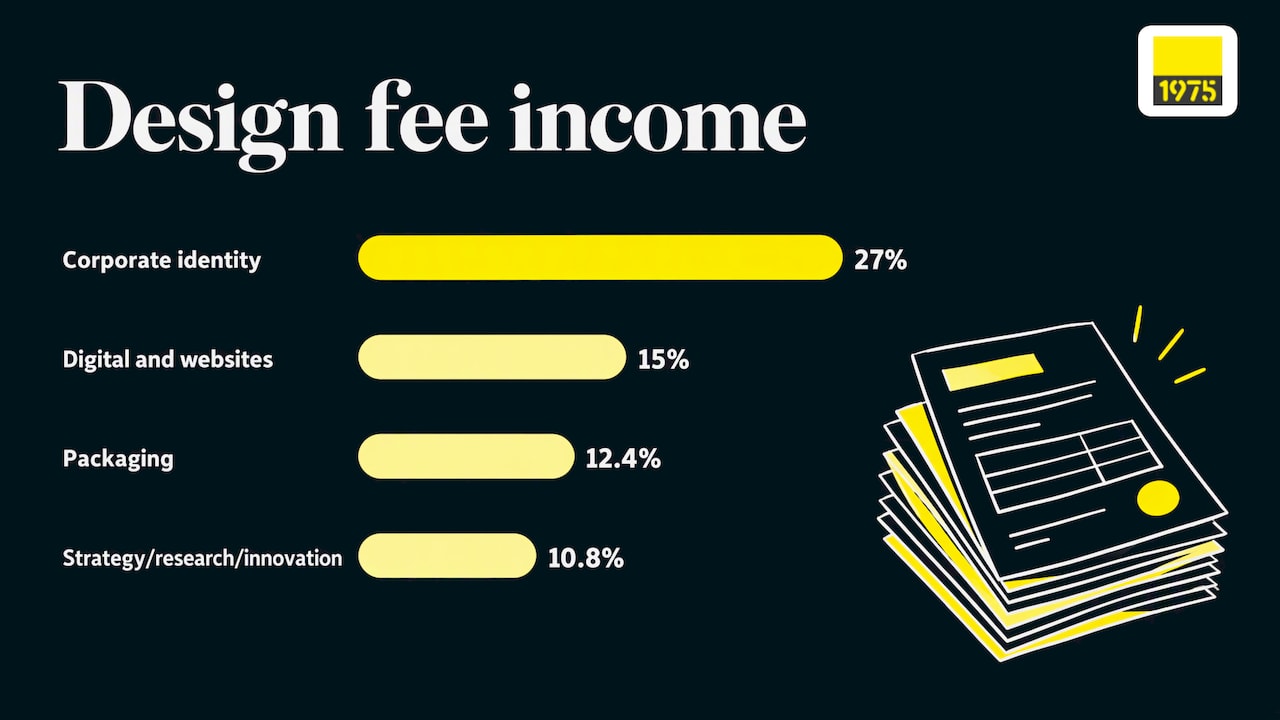
The order matters. The DBA’s 2023 annual survey of its member agencies found corporate identity and branding was the most prevalent discipline, at 27% of fee income, ahead of digital and websites at 15%, packaging at 12.4% and strategy, research and innovation at 10.8%. Businesses that hire professional designers put the most money into the foundation, because everything else is built on it.
If your marketing leans on brochures, flyers, sales sheets and similar pieces, our guide to marketing collateral design goes into the detail. If you publish regular content, digital publication design is the equivalent for magazines and reports.
Four principles that make marketing design work
You do not need to be a designer to judge whether a piece is working, but a few principles explain most of the difference between polished and messy. Adobe’s UK marketing guide names four as the hard-and-fast rules of successful design:
- Proximity. Group related elements so the eye is guided to the key message. If your offer, price and button are scattered, nobody finds them.
- Alignment. Elements that line up look deliberate and trustworthy. Misalignment reads as carelessness, even when readers cannot say why.
- Repetition. Repeating colours, type and shapes can typify a brand, in Adobe’s words. This is the principle that builds recognition over months.
- Contrast. Differences in size, weight and colour show what matters most and keep text legible.
The same guide stresses that these principles do not change between formats. Digital brochures, posters, online ads, landing pages, microsites and websites all need excellent user experience. A brand that holds these four principles across formats looks like one company, whether the customer meets it on a phone, in a magazine or on a conference stand.
Accessibility belongs in the same conversation. Rasmussen University’s guide advises alternative text and high-contrast visuals for social media. Strong contrast helps every reader, and standards such as WCAG 2.2 AA, covered in this piece on accessible website design, set out what accessible design looks like on the web. Build it into the brief and it costs far less than retrofitting.
Build the brand system first, then the campaigns
The quickest way to waste a design budget is to commission campaign pieces before the identity is settled. Each piece then reinvents the look, and the total never adds up to a brand.
Adobe’s visual identity guide calls visual identity a core component of brand identity, the visual face of a company, and says a graphic charter (your brand guidelines) should specify:
- logo usage: sizing, spacing, clear space and colour variations
- colour codes in hex, RGB, Pantone and CMYK, so screen and print match
- typography rules
- icon usage and photography guidelines
- layout standards, with do’s and don’ts and real-world examples
That list is a practical test of any identity project. If your guidelines cover those items, a new team member, freelancer or printer can produce on-brand work without asking. If they do not, every new asset needs a decision, and decisions drift.
If your current identity no longer matches the business, our practical UK guide to rebranding a business explains the process. For the logo itself, see what to budget for logo design in the UK. If you run several brands or sub-brands under one roof, brand architecture shows how to organise them so the marketing stays clear.
Adapt the design to audience, message and channel
One identity does not mean one layout. The system stays fixed while the expression flexes. Three questions decide how:
Who is the reader, and how much time do they give you? A procurement director reading a capabilities brochure at a desk will give a page real attention. Someone scrolling will give a graphic about a second. The first needs structure, depth and elegant typography. The second needs one idea and one focal point.
What is the single message? Every piece should have one thing it wants the reader to do or remember. Design the hierarchy around it: the largest, highest-contrast element should be the one that matters.
Which channel is it for? Email headers, social graphics, ads, landing pages, printed brochures and digital magazines all have different shapes and reading habits. Marketing design covers digital and print formats alike, from email and social campaigns to newsletters, flyers and posters, as Figma’s resource library sets out. Plan the family of formats at the start, not after the first one is finished.
Consistency across channels also has a social side: your audience sees you on several platforms and judges credibility from how coherent you look. Our own view is that coherence is earned in the design system and the art direction, not bought afterwards.
Set objectives before the brief, and measure against them
Design is often judged by taste in a meeting room. A better test is whether it did what you asked. The Design Council’s Design Buyers’ Guide says clear objectives make it easier to measure design investment, and advises agreeing quantifiable measures even for projects such as corporate rebranding. It also recommends reviewing deadlines, milestones and budgets and learning from any problems.
Translate that into a one-page brief:
- Goal. For example: raise enquiries from a target sector, lift renewals of a membership publication, or make a sales deck easier to present.
- Measure. Pick the number that shows it: enquiry volume, click-through on a campaign, readers reaching the end of a magazine issue, time to produce a new piece.
- Audience. Who, specifically, and what they already think of you.
- Formats. The assets the project must deliver and where they will be used.
- Milestones and budget. Review points, so problems surface early.
Compare results with the starting position, not with a vague impression. A rebrand that does nothing visible to enquiries but halves the time your team spends producing material still has a measurable return. Decide in advance which outcomes count.
How to brief a studio so the work stays cohesive
The cleanest route to cohesive marketing is one studio responsible for the thread that runs through identity, art direction and publications. When these are split across several suppliers, the brand gets interpreted each time, and the join shows.
When you brief, give the studio:
- your business goal and the measure that will show it worked
- who the audience is, and what you want them to do
- the formats and channels, including print
- examples of work you admire and work you want to avoid
- any existing guidelines, assets or constraints
If you are choosing between providers, our practical guide to choosing a graphic design agency in the UK lays out the questions to ask. Look for case studies in your sector and for evidence that the studio can carry one idea through everything from logo to campaign to publication.
Where 1975 fits
We are a graphic design studio in Norwich, creating brands and digital magazines since 2007. Our services cover brand identity, art direction for campaigns and photoshoots, design consultancy including audits, and the design and production of digital magazines, brochures and corporate literature. What sets us apart is the integration: art direction and branding are handled together, underpinned by a commitment to storytelling through design, so your marketing material looks and reads as one voice.
The outcome you are buying is a brand that is easier to recognise, easier to extend and easier to produce for. Our case studies include work with the Royal Town Planning Institute and Inside Networks, and you can see the range in our portfolio, including branding projects and digital magazines.

If you want to talk through a brand, a campaign or a publication, start at 1975.co/about to see our four services, or go to the home page to get in touch.
Our perspective on marketing graphic design
Most marketing design problems we see at the briefing stage are not problems with individual pieces. They are problems of connection: a good logo that no one has built a system around, a campaign that does not look like the brochure, a magazine that feels like a different company from the website.
We work on the basis that identity, art direction and publication design are one job. When the same people shape the brand and then direct the photography, the campaign and the layout, the story stays consistent, and your team stops spending time policing the look and gets on with the marketing.
That is why we treat storytelling as a design tool. A brand with a clear story has an obvious answer to what the next piece should look like. That is the outcome we design for: material that your audience recognises at a glance, and that your team can extend with confidence.
the author
FAQ
Does graphic design come under digital marketing?
It overlaps with it but is a separate skill. Graphic design creates the visual materials, which can be used online or in print, while digital marketing plans and measures campaigns across online channels. The two work best together, because the design determines how well the campaign communicates.
What is marketing graphic design used for?
It promotes products, services or ideas through visual assets such as landing pages, email campaigns, social graphics, brochures, presentations and digital magazines. Its job is to make your message clear and your brand recognisable in each one.
How do I know if my marketing design is working?
Set objectives before the project and agree a measure for each, such as enquiries, click-through or readership. The Design Council’s buyers’ guide recommends quantifiable measures even for rebranding. Review milestones and budgets along the way, then compare results with where you started.
Should I fix my brand identity before commissioning campaign design?
Yes, in most cases. A defined identity with guidelines for logo use, colour, typography and imagery means every campaign piece starts from the same rules. That keeps your marketing consistent and makes each new asset quicker to produce.
Sources
- Marketing Design Explained: Types, Tips, and Best Practices (Shopify)
- What Is Graphic Design? How Graphic Design Works (Shopify)
- Company spending on design: Exploratory survey of UK firms (Design Council)
- Graphic Design vs Digital Marketing: Differences (Bryant & Stratton)
- What Clients Think 2023 (Design Business Association)
- 2023 DBA Annual Survey Report (Design Business Association)
- What Is Graphic Design? (Figma)
- Graphic Design in the Modern World: What Marketers Need to Know (Adobe UK)
- Visual Identity Design Guide (Adobe UK)
- How Graphic Design is Used in Business and Marketing (Rasmussen University)
- Design Buyers’ Guide (Design Council)
Recommended
- Marketing Collateral Design: What It Is and How to Get It Right
- Business Presentation Design: Slides That Win Decisions
- Cost for Logo Design in the UK: What to Budget in 2026
- Choosing a Graphic Design Agency in the UK: A Practical Guide
No Comments
Comments are closed.