
A brand strategy process takes you from “who are we, and why should anyone choose us?” to a decision-ready brief that your identity, your messaging and your marketing can all follow. It runs in seven stages: discovery, audience, positioning, messaging, visual identity, guidelines and rollout, and measurement. The businesses that get the most from it keep strategy and design in the same room. That is how we work at 1975, the Norwich graphic design studio that has been building brands and digital magazines since 2007.
TL;DR
- Brand strategy is a set of choices: who you serve, what you stand for and how you will show it. It comes before the logo, not after.
- The seven stages are discovery, audience, positioning, messaging, visual identity, guidelines and rollout, and measurement.
- Discovery decides the quality of everything after it. Skipping it produces a brand that looks fresh and says nothing.
- Strategy works best when the people who write it stay involved while the identity is designed.
- Plan for a year or more before judging results, and measure against goals you set at the start.
Table of Contents
- What a brand strategy is, and what it is not
- Stage 1: Discovery, the work before the work
- Stage 2: Define the audience you are choosing
- Stage 3: Positioning and differentiation
- Stage 4: Purpose, values and messaging
- Stage 5: Turn strategy into a visual identity
- Stage 6: Guidelines and rollout
- Stage 7: Measure whether it is working
- What the process should cost you in time
- Our view: strategy and design belong together
- Work with a studio that joins strategy to design
- FAQ
- Sources
What a brand strategy is, and what it is not
A brand strategy is the long-term plan for how your organisation is understood: its purpose, its audience, its position against alternatives and the way it speaks and looks. A brand identity is the visible part of that plan: the logo, colours, typography, imagery and layouts. A marketing strategy sits beneath both and covers the campaigns and channels that chase leads and sales in the near term.
The order matters. Strategy tells the designer what the identity must communicate. Without it, a design brief becomes a matter of taste, and taste is hard to defend in a boardroom. With it, every design decision can be checked against a clear question: does this make us more recognisable to the people we want?
The stages below follow the way professional branding projects are normally run. Where the UK government or industry bodies give guidance, we link to it.
Stage 1: Discovery, the work before the work
Discovery is where you collect the evidence a strategy rests on. The charity sector’s Brand 360 guide from CharityComms describes it as desk research into your history, corporate strategy and existing audience research, alongside primary research such as experiencing the organisation first-hand, a look at how peers in other sectors position themselves, a brand audit, and interviews or workshops with stakeholders. The output is a debrief of key findings.
In practice, ask for these five things before any creative thinking starts:
- Your business plan and any current brand material, so the strategy supports where you are heading rather than where you have been.
- Customer data: who buys, who stays, who leaves and why.
- Interviews with your own people, from the founder to the person who answers the phone.
- A review of what every current touchpoint says about you, from the website to the proposal template.
- A view of the competitive landscape.
The marketing academic Mark Ritson makes the same argument in his essay Three axioms and three questions: diagnosis comes before strategy. He suggests brand tracking, updated segmentation and conversations with loyal customers as the raw material.
Where it goes wrong: teams treat discovery as a formality, or let it be driven by opinion. The loudest voice in the room becomes the brand. Evidence from customers and staff settles the argument.
Stage 2: Define the audience you are choosing
Business.gov.uk, the UK government’s guidance site for business, suggests describing your target customer by who they are (age, location, demographics), where they are (how they find and engage with your brand) and how they behave (which language or visual cues speak to them). That last point feeds straight into tone and style later.
The discipline here is choosing. A brand that tries to appeal to everyone has no edge with anyone. Ritson’s framing is that strategy is about choices, including what you decide not to do. For a B2B firm that might mean naming the two or three buyer types you will win, and accepting that your language will not suit a fourth.
A useful test: can you describe your primary audience so precisely that a designer could picture where they read, what they scroll past and what they trust? If not, the audience is still too broad.
Stage 3: Positioning and differentiation
Positioning is the single sentence of difference: what you offer, to whom, and why that matters more than the alternatives. Business.gov.uk’s competition guidance says to find out how much competitors charge, how they advertise, how they make or provide what they sell, and what makes your business different and where you could fit in the market.
Two practical habits help:
- Map competitors by what they say, not what they sell. Collect their homepages and strip out the logos. If the words are interchangeable, you have found the space you can own.
- Choose the proof. A position is only credible if you can back it with something concrete: a result, a method, a client, a history. Claims without proof get ignored.
If differentiation is your central challenge, our guide to brand differentiation goes deeper. If you run more than one product, division or sub-brand, settle how they relate before you finish positioning, using our overview of brand architecture.
Stage 4: Purpose, values and messaging
This is where the strategy gets written down in words. Business.gov.uk says to be clear on why your business exists, your values and what you stand for, and what problems you solve. CharityComms points to the same foundations: what you stand for, why you exist, what you do and how you do it.
The brand strategist Sarah Robb, who studied 182 of the world’s most valuable brands, found they all answered the same four questions: why do we exist, what do we do, who are we and how do we do things, and how does the brand look, feel and sound. Those four questions make a good skeleton for a one-page brand strategy.
A workable messaging set contains:
| Element | What it does | Test |
|---|---|---|
| Purpose | Says why the organisation exists beyond making money | Would staff repeat it unprompted? |
| Positioning statement | Names audience, offer and difference | Could a competitor sign it? If yes, rewrite |
| Core message | The one idea you want remembered | Can it be said in a breath? |
| Proof points | Evidence behind the claim | Are they specific and checkable? |
| Tone of voice | How you sound across channels | Could someone identify it with the logo hidden? |
Keep the language plain. Strategy documents full of jargon get filed and forgotten, and the people who need to use them cannot.
Stage 5: Turn strategy into a visual identity
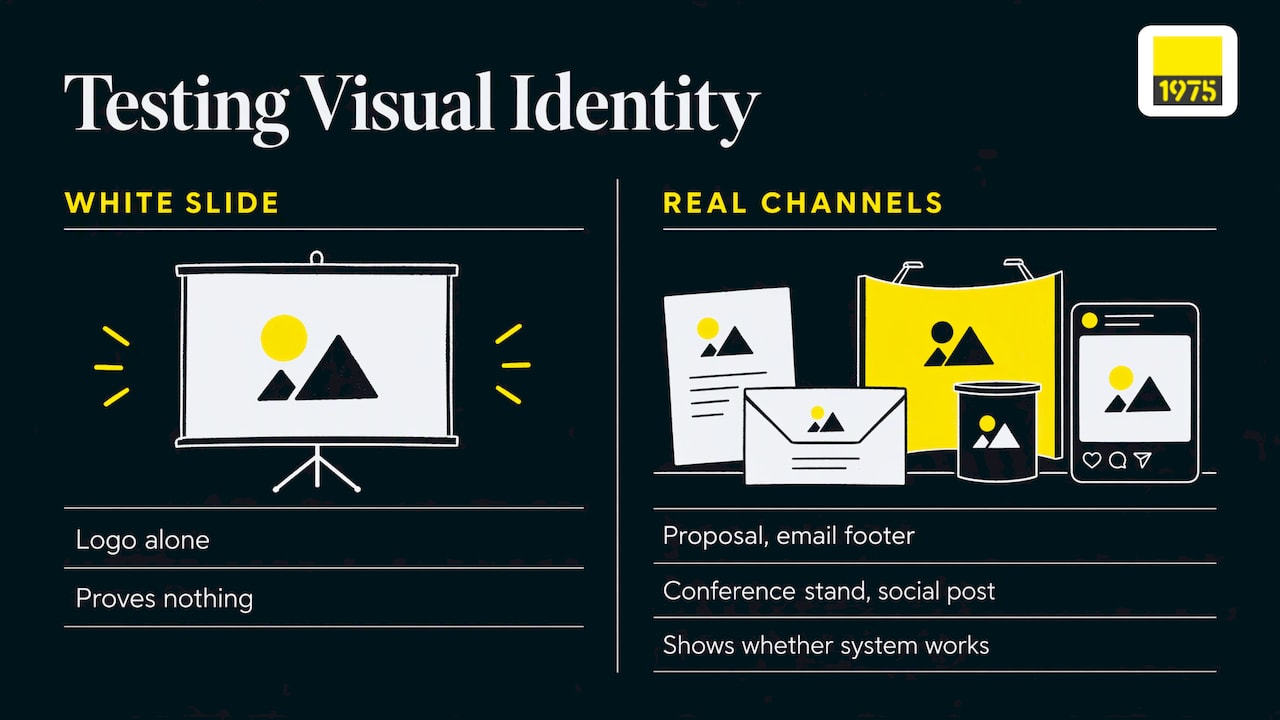
Only now does design begin in earnest. CharityComms lists what a coherent identity system contains: logo, social media icon, colour palettes, typography, photography, graphic devices, illustration and iconography. It also recommends keeping the brand consultant in the creative team, so strategy and creativity work together, and applying early design concepts to real examples across the main channels and departments.
That last point is the most useful one in the whole process. A logo on a white slide proves nothing. The same logo on a proposal, an email footer, a conference stand and a social post shows quickly whether the system works.
If you are budgeting for the design work, see what to expect in our guide to the cost of logo design in the UK. If the brand also needs to be expressed in publishing, the digital publication design guide shows how identity carries into magazines and long-form content.
Where it goes wrong: the designer receives a slogan and a mood board but never sees the research. Without the reasoning behind the strategy, they cannot make the thousand small judgement calls a brand needs.
Stage 6: Guidelines and rollout
Guidelines turn the identity into something other people can use correctly. They cover logo use and clear space, colour values, type, image style, layout principles, voice and examples of the brand in action.
CharityComms advises embedding the brand internally first: staff and volunteers are a ready-made salesforce. Only then do you activate externally through owned, earned and paid channels, usually over several years and often beginning with a digital marketing strategy and one piece of hero content that brings the brand story to life.
Consistency across every point of contact is what makes a brand build value. Research published by Frontify with Harvard Business Review, quoting the brand expert Favaro, says lasting brands are built by consistently strengthening familiarity, regard, meaning and uniqueness across all five Ps of customer touchpoints: product, price, promotion, place and people. In other words, the strategy has to show up in the product and the people as well as the advertising.
A sensible rollout order:
- Launch internally with a short briefing, not just a PDF.
- Update the highest-visibility assets first: website, email, proposals, social profiles.
- Replace lower-visibility items such as signage and templates as they come up for renewal.
- Commission one flagship piece, such as a brand film, a campaign or a digital magazine, that shows the brand at its best.
If you are changing an existing brand, our practical guide to rebranding a business covers the transition in more detail.
Stage 7: Measure whether it is working
Qualtrics describes a brand strategy as a north star for decisions about what you do and do not do, and recommends letting it run for at least a year so you can set goals and evaluate progress. Do not judge a new brand after a quarter.
Frontify’s research makes a point worth acting on: measure familiarity, regard, meaning and uniqueness relative to major brands that reflect your country’s culture, not only direct category rivals. Favaro also suggests identifying which positioning attributes (purposeful, emotional, functional or experiential) matter most to your market and building on those.
Set a short list of measures before launch, for example unprompted and prompted awareness, how closely customers describe you in the words you intended, enquiry quality, and consistency scores from an audit of your own materials. Our guide to brand metrics explains what to track and how to use it.
What the process should cost you in time
Timescales vary with the size of the organisation and the number of audiences, so treat any fixed duration with caution. What you can plan for is the sequence. Discovery and audience work are front-loaded and need your people’s time. Positioning and messaging need decision-makers in the room. Identity design runs in rounds, and rollout continues for months after the launch date.
The most common cause of delay is not creative. It is sign-off: too many approvers, no single owner for the brand. Name one person with authority at the start.
Our view: strategy and design belong together
We started 1975 in Norwich in 2007 because we kept seeing the same split: strategy written in one place, design done in another, and a brand that lost something in the handover.
Our approach joins art direction and branding, and storytelling sits under all of it. The story you uncover in discovery is the one the identity should tell, whether it appears on a logo, a photoshoot or the pages of a digital magazine.
That integration is what gives a brand coherence. When the people shaping the strategy also shape how it looks, the idea is not diluted on the way to the page. Our work for the Royal Town Planning Institute and Inside Networks shows what that looks like across very different organisations.
The outcome you are buying is not a document. It is a brand that your team can explain, your customers can recognise and your marketing can build on for years.
the author
Work with a studio that joins strategy to design
If you are a business seeking a distinctive identity, a publisher who needs an engaging digital magazine, or a marketing team that wants a cohesive brand, we can help you through these stages. Our services cover brand identity, art direction, design consultancy including audits, and digital magazines, brochures and corporate literature. See what we do or browse the branding projects we have delivered.

If you are choosing a partner, our guide to choosing a graphic design agency in the UK sets out what to look for. Charities and membership bodies can read how a nonprofit branding agency approaches the work.
FAQ
How do you write a brand strategy?
Start from the evidence: your business plan, customer insight and a view of your competitors. Then answer the core questions: why you exist, who you serve, how you are different and how you will sound and look. Write the answers on one page in plain language, and test them against real customers and staff before design begins.
How is brand strategy different from marketing strategy?
Brand strategy deals with long-term perception: what you stand for and how you want to be understood. Marketing strategy covers the campaigns, channels and targets that drive leads and sales in the shorter term. The brand strategy is the foundation the marketing plan builds on, which is why it is written first.
What research should I do first?
Begin with desk research on your own documents and existing audience data, then interview stakeholders and customers, audit your current brand and study how peers present themselves. Business.gov.uk also recommends looking at how competitors price, advertise and deliver. Summarise the findings in a short debrief before you start positioning.
How long should a brand strategy run before I judge it?
Give it at least a year. That allows time to launch, embed the brand with your team, run activity across channels and compare results with the goals you set. Choose your measures before launch so you have a baseline to compare against.
Sources
- Creating your business brand, Business.gov.uk
- Brand 360 guide, CharityComms
- Three axioms and three questions, Mark Ritson
- Cut the Jargon: Simplifying brand strategy for better results, Unicorny
- Brand Strategy: Definition and Guide, Qualtrics
- Building Strong Brands: Investing in Long-Term Branding, Frontify and HBR
Recommended
- Digital Content Strategy: A Practical Guide for UK Teams
- Brand Architecture: Models, Types and How to Choose
- Rebranding a Business: A Practical UK Guide
- Brand Differentiation: How to Stand Out and Be Chosen
No Comments
Comments are closed.