
Creative art direction is the discipline that decides how a brand or publication looks, feels and behaves, then keeps that decision consistent across every page, screen, photograph and campaign. Done well, it gives a business a recognisable identity, gives a magazine a voice readers return to, and saves marketing teams from re-arguing the same visual choices on every project. At 1975, a graphic design studio in Norwich working since 2007, we treat art direction and branding as one job, because a brand only becomes memorable when the thinking and the visuals come from the same place.
TL;DR
- Art direction sets the visual idea behind a brand, campaign or publication and oversees how it is carried out, so the finished work looks like one voice.
- It is not the same as graphic design: designers produce the pieces, art direction decides what they should say and how they fit together.
- Its payoff is recognition: consistent use of distinctive brand codes builds memory with your audience over time.
- Bring it in at the start of a rebrand, a magazine launch or a campaign, before layouts and shoots are commissioned.
- Expect a process of brief, concept, references, feedback and supervised production, with one clear point of contact on your side.
Table of Contents
- What creative art direction actually means
- What a creative art director does
- Art direction, creative direction and graphic design
- What good art direction delivers
- When to involve an art director
- How the process runs, from brief to rollout
- What it costs and how to budget
- Questions to ask before you commission
- Perspective: why we keep art direction and branding together
- Working with 1975
- FAQ
- Sources
What creative art direction actually means
The phrase covers a simple idea. Someone takes responsibility for the visual point of view and makes sure every contributor works to it. The Institute of Practitioners in Advertising describes art directors as people who create and develop ideas with a particular focus on how they look, across print, film, mobile applications and websites.
For publishing, the University of the Arts London puts it as bringing a magazine’s images, layouts and other elements together under one overarching viewpoint to engage its target audience. The same guide makes a point worth remembering when you write your own brief: visual communication should be made clearly for its audience, and nobody can expect to appeal to everyone.
That last point is where many projects go wrong. A brand that tries to look right to everybody ends up looking like nobody in particular. Art direction is the act of choosing, and then defending the choice.
Who it is for
This guide is written for four kinds of reader:
- Businesses that need a brand identity that stands apart from competitors in a crowded market.
- Publishers who want a digital magazine people finish reading, not one they skim and close.
- Organisations that produce reports, campaigns and events and want them to look like they come from one body.
- Marketing teams that have a brand but see it drifting across channels and agencies.
If you want to become an art director yourself, salary tables and career routes are a different subject. Here we deal with what art direction does for the organisation that commissions it.
What a creative art director does
The role is part vision, part management. The IPA lists the core duties: understanding the client’s context, communications need, audience and proposed media; interpreting the brief; communicating concepts through references or storyboards; choosing creative contributors; and overseeing execution. Decisions cover the visual treatment, who collaborates, and how the work develops through feedback and production.
UK publishing shows the same shape at scale. The Publishers Association describes the publishing art director as responsible for the art and design of books, managing a team that covers cover design and picture research, working with agencies, freelancers, photographers and illustrators, and keeping budgets and deadlines under control while liaising with editorial and sales.
A Penguin Random House children’s art director describes the job as overseeing rather than doing hands-on design: coordinating a large design team, matching each project to the best-suited designer, acting as a second pair of eyes, and using covers meetings so everyone is on board before design begins in earnest.
The practical lesson is that art direction is a decision-making layer. It sits above the individual layouts, logos and photographs, and it is the reason they agree with each other.
It is collaborative, not a matter of taste
It is tempting to picture an art director as a lone arbiter of taste. Practitioners describe something different. Figma’s brand studio team characterises art direction as communication-based work: selecting, editing and filtering visual inputs, trusting contributors and steering them towards the brief. For you as the client, that means your input matters. A good art director draws out what your audience needs and what your business stands for, then turns it into a direction that photographers, illustrators and designers can follow without guessing.
Art direction, creative direction and graphic design
These terms overlap, and you will see them used loosely. A workable way to separate them:
| Discipline | Question it answers | Typical output |
|---|---|---|
| Graphic design | How should this piece be laid out and finished? | A page, logo, brochure, social asset |
| Art direction | What visual idea should all the pieces share, and who makes them? | Visual direction, references, shoot briefs, supervised production |
| Creative direction | What is the overall strategy and set of values the creative work expresses? | Framework that art direction and copy both serve |
The designer Veronica Ditting, in a conversation with HURS, describes creative direction as defining a project’s core framework and its editorial and visual values, with art direction as one aspect within it. In a studio of our size those layers often sit with the same people, which is an advantage: the person who shapes the idea also sees it through to the final page.
The practical difference for a buyer is simple. A designer can make you a good brochure. Art direction makes sure the brochure, the website, the photography and the magazine look like they belong to one organisation.
What good art direction delivers
The outcomes are concrete, and they show up in recognition, speed and quality.
Recognition that compounds
Diageo’s Global Design Director Jeremy Lindley says in the company’s 2025 article on creative consistency that consistent design helps people recognise work and associate it with a brand, and that distinctive brand codes should be protected and used in fresh, unexpected ways. The same piece argues that this consistency builds memory and salience for the brand.
That is the commercial case in one sentence. Each time your audience meets your work and recognises it, the earlier impressions add up. Inconsistent work resets the count.
One identity across very different formats
The best-known UK examples show how a system stretches without breaking:
- The Herdy founders told Design Week that a continuing core palette and set of design principles let the brand carry its character from greeting cards to illustrated books, with a brand manual defining visual style, proportions and colour, and an approval process for licensed products.
- Its Nice That reports that the Faber Editions cover system uses typographic hierarchy, a limited palette and a contrasting branding strip to connect titles while letting each cover keep its own personality.
- Dezeen reports that the Thames & Hudson identity was built for print and digital, from narrow book spines to wide banners, with three symbol sizes for different spine widths and a shared baseline for consistency on shelves.
The pattern is the same each time: a small number of firm rules, plus room for variety inside them. That is what art direction produces, and it is what a brand guideline alone cannot produce without someone applying it.
Using familiar codes in fresh ways
Consistency does not mean repetition. Brands that stay lively reuse their colours, type and motifs in new settings. Live activations are a good test, because guests photograph what looks distinctive and share it. These brand activation photo ideas show how an established look can be turned into something people want to capture, which is exactly what a strong set of brand codes allows.
Faster, calmer production
When the direction is clear, designers, photographers and printers stop asking what you meant. Fewer rounds of revision, fewer off-brand pieces to fix and fewer arguments about taste follow. Teams that work to a shared direction spend their time on the idea, not on reconciling styles.
When to involve an art director
The earlier the better. Visual decisions made without direction are expensive to unpick because they spread: a colour choice reaches the website, the stationery, the deck and the stand before anyone notices it does not work. Four moments stand out.
- Before a rebrand or new brand identity. The direction determines the logo, type, colour, imagery and tone, so it should lead the work and not be added afterwards. Our guide to rebranding a business covers the wider process, and brand architecture matters if you run several products or divisions.
- Before launching or relaunching a magazine. The format, grid, photography and typographic voice need to be decided together. See our guide to digital publication design and what to expect from a magazine design agency.
- Before a campaign or photoshoot. Casting, locations, styling and retouching all follow from one visual idea. Fixing a weak shoot afterwards costs far more than directing it properly.
- When your brand has started to drift. Several agencies, freelancers and in-house staff each interpreting the guidelines produce a patchwork. A design audit and ongoing direction bring it back together.
If you are weighing up which type of provider to hire for any of this, our practical guide to choosing a graphic design agency in the UK sets out the questions to ask.
How the process runs, from brief to rollout
The stages are broadly the same whether the output is a logo, a campaign or a magazine. The IPA’s account runs as follows: understand the context, need, audience and media; develop ideas with references or storyboards; incorporate feedback; select contributors; oversee production.
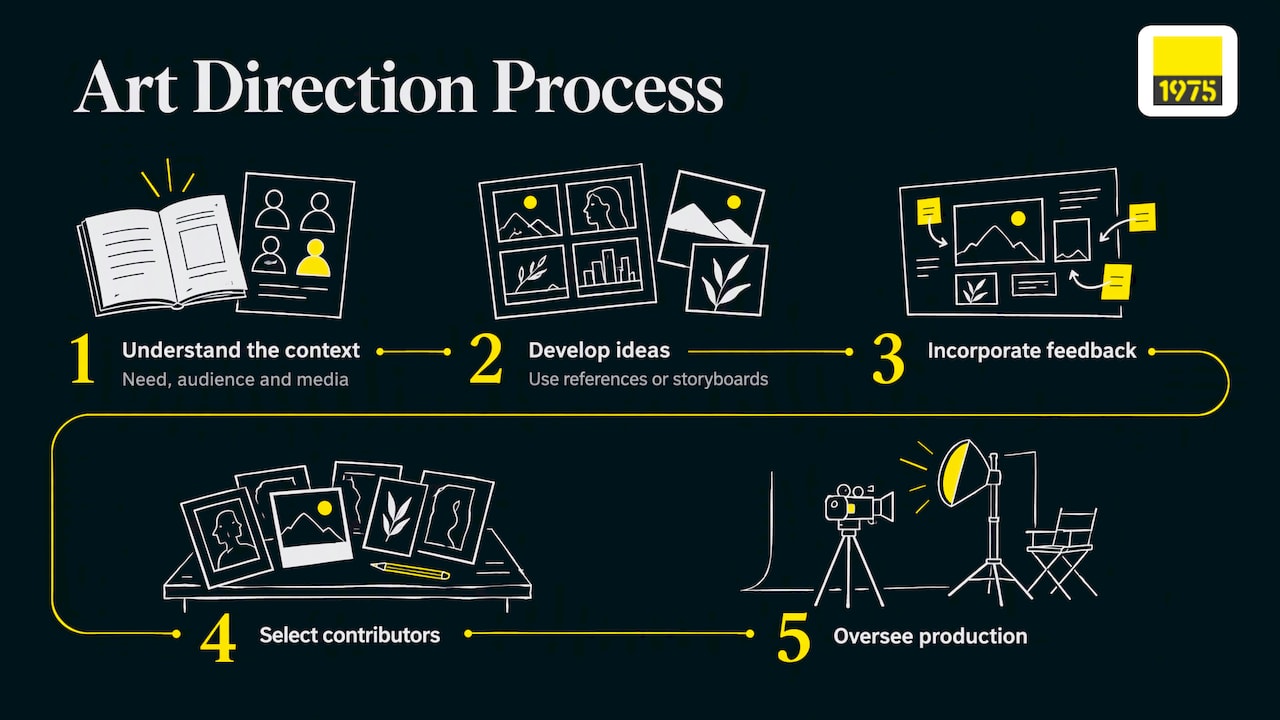
1. Brief and context
This is where most of the value is set. You explain what the organisation does, who you need to reach, where the work will appear and what success looks like. The sharper the audience, the stronger the direction. Diageo says it immerses creative partners in its brand archives, brand homes and live experiences before briefing them, so they absorb heritage first. The principle scales down: the more your art director understands about your business, the less the work looks generic.
2. Concept and references
Expect a visual idea expressed through mood boards, type and colour studies, sample layouts or storyboards. For magazines, the UAL guide uses four ideas to shape the work: formula, function, format and frame. In plain terms, what the publication consistently offers, what the reader uses it for, its physical or screen shape, and how it presents its content.
3. Review and refinement
The Design Council’s Design Buyers’ Guide advises building formal review meetings into the plan, where the designer presents concepts or mock-ups, and agreeing early who has sign-off responsibility. It also recommends a single point of contact on the client side and a joint project plan with timescales. These three things prevent most delays. Name the person who can say yes before the first presentation.
4. Production and supervision
This is the stage that separates art direction from a set of nice sketches. Photographers are briefed, images are selected and edited, layouts are built, and every piece is checked against the direction before it goes out. In digital magazines, that includes how pages behave on screen as well as how they look.
5. Rollout and guardrails
The direction is documented so others can use it: a brand manual, templates and approval steps, much as Herdy’s founders describe. Without this stage, the look slowly dilutes as new people pick up the work.
What it costs and how to budget
Studios price art direction by project, not by a fixed rate card, which is why we publish no standard fee. Scope drives the cost: a full identity with guidelines, a twelve-issue magazine programme and a one-day shoot are very different jobs.
For context on how design time is priced in the UK, the Design Council’s guide classifies designers as junior (one to two years), middle-weight (three to six years), senior (at least seven years) and creative director, and says day rates run from £200 to £1,500 depending on specialism and experience. It adds that a large project may involve several levels at different rates. The useful takeaway is that who does what on your project affects the budget as much as how long it takes. A clear brief and a single decision-maker on your side keep both under control.
Questions to ask before you commission
Whatever route you take, a few questions reveal whether art direction is really on offer:
- Who sets the visual direction, and will they stay with the project through production?
- Can they show work where branding, photography and layout clearly belong together?
- How will the direction be documented so your team can apply it later?
- Have they worked with an audience like yours, in a sector like yours?
- Who on their side will you speak to week to week?
Portfolios answer most of these. Look for range inside consistency: different pieces that are plainly from the same hand.
Perspective: why we keep art direction and branding together
We started 1975 in 2007 on one belief: a brand is a story told through design, and somebody has to be responsible for telling it the same way everywhere.
That is why we do not separate the people who build the identity from the people who direct the photography and the pages. When the same studio shapes the logo, the colour, the magazine grid and the shoot, nothing gets lost in translation, and the client deals with one point of view instead of three.
For publishers, this means a digital magazine that feels authored: the cover, the features and the advertising all speak with one voice. For businesses, it means an identity that still looks like itself in a brochure, a presentation and a campaign. Our work for the Royal Town Planning Institute and Inside Networks shows how that integrated approach plays out for very different audiences.
What we ask of clients is a clear brief, a named decision-maker and a willingness to choose. We bring the detail, the references and the discipline to carry the choice through.
the author
Working with 1975
We are a graphic design studio in Norwich offering brand identity, art direction, digital magazines and design consultancy, including audits, for businesses, publishers and organisations. Art direction sits at the centre of what we do: we direct campaigns and photoshoots, then carry the same visual thinking into the logo, the guidelines and the printed or digital page.

If you want to see how that looks in practice, browse our art direction work, the Inside Networks case study and our branding projects. When you are ready to talk about a brand, a magazine or a campaign, start from our services page and tell us what you need the work to achieve.
FAQ
What does a creative art director do?
They set the visual idea behind a brand, campaign or publication and oversee how it is produced. According to the IPA, that includes interpreting the brief and audience, communicating concepts through references, choosing creative contributors and supervising execution. The aim is that every piece looks like part of one whole.
Is art direction the same as graphic design?
No. Graphic design produces individual pieces such as layouts, logos and brochures. Art direction decides the visual idea those pieces share and guides the people making them. Many projects need both, and the best results come when the same studio handles both.
How is art direction different from creative direction?
Creative direction sets the overall framework, strategy and values of a project, while art direction is the visual part within it. In smaller studios the two roles are often shared, so you deal with one team for both the idea and its look.
When should I bring in art direction for a magazine or brand?
At the start, before layouts, logos or shoots are commissioned. Early direction decides the format, imagery and typography together and prevents inconsistent choices spreading across your channels. It also helps when an existing brand has begun to drift between teams and suppliers.
How much does creative art direction cost?
It depends on scope, so there is no single figure. The Design Council notes that UK day rates range from £200 to £1,500 depending on specialism and years practising. A clear brief, one decision-maker and a joint project plan keep the total predictable.
Sources
- IPA: Art Director
- UAL: What is magazine creative direction?
- Publishers Association: Art Director
- Penguin: How does a design team work in collaboration?
- Figma Blog: The Art of Art Direction
- HURS: The Ditting Effect
- Diageo: Creative consistency
- Design Week: Herdy Q&A
- Its Nice That: Faber Editions cover system
- Dezeen: Thames & Hudson rebrand
- Design Council: Design Buyers’ Guide
- Brand activation photo ideas
Recommended
- Art Direction Archives
- Choosing a Graphic Design Agency in the UK: A Practical Guide
- Magazine Design Agency: What You Get and How to Choose
- Marketing Collateral Design: What It Is and How to Get It Right
No Comments
Comments are closed.